

- What Is Normal Aging? The Forgetfulness That Is Nothing to Worry About
- What Is Dementia? When Forgetfulness Becomes Something More
- Key Differences — Normal Aging vs Dementia
- Real Life Examples Pakistani Families Will Recognize
- 7 Warning Signs That It Is NOT Normal Aging
- What Should You Do If You Are Worried?
- How Will the Doctor Actually Test My Loved One?
By Afsheen Tariq | Mental Health Matter
Have you ever watched your elderly mother forget where she put her glasses and wondered — is this just old age, or is something more serious happening? Have you noticed your father repeating the same story twice in one evening and felt a quiet fear creep into your heart?
If you have, you are not alone. Thousands of Pakistani families ask themselves this exact question every single day. And most of them don’t know the answer — because no one ever taught us the difference between dementia vs normal aging in Pakistan.
In our culture, we often say “Ammi ki umar ho gayi hai” — she has gotten old. We dismiss the signs. We wait. And sometimes, we wait too long.
This article is for every Pakistani son and daughter who is worried about their elderly parent. By the end, you will know exactly what is normal, what is not, and what to do if something feels wrong.
What Is Normal Aging? The Forgetfulness That Is Nothing to Worry About
As we grow older, our brains naturally slow down a little. This is completely normal and happens to everyone. It does not mean dementia. It does not mean something is seriously wrong.
Here are examples of normal aging that Pakistani families often see in their elderly parents:
- Forgetting a name temporarily — Your father forgets the name of a distant relative at a wedding but remembers it later that evening. This is normal.
- Misplacing things occasionally — Your mother puts her phone in the kitchen and forgets where she left it. She searches and finds it herself. This is normal.
- Taking longer to learn new things — Your elderly uncle struggles to learn how to use WhatsApp. It takes him a week but he eventually figures it out. This is normal.
- Moving more slowly — Your grandmother walks at a slower pace than she did twenty years ago. Her thinking may also be a little slower. This is normal aging.
- Forgetting an appointment once — Your father forgets a doctor’s appointment he had last week but remembers when you remind him. This is normal.
The key word in all of these examples is temporarily. In normal aging, memory slips happen but the person can usually recall the information later or with a small reminder. Their daily life continues without major disruption.
What Is Dementia? When Forgetfulness Becomes Something More
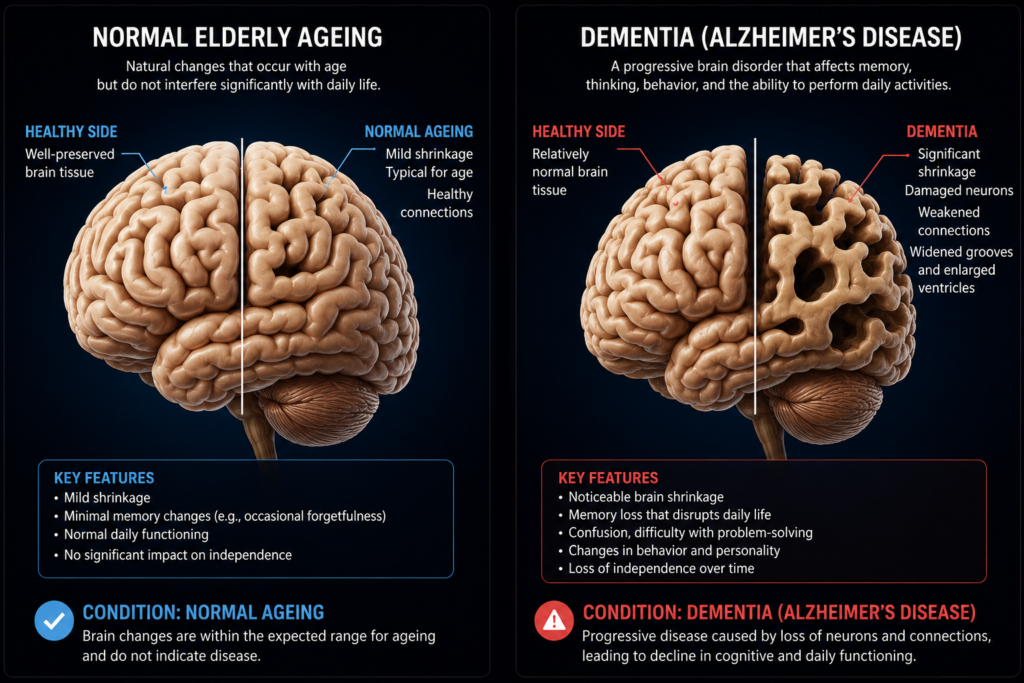
Dementia is not a normal part of aging. It is a medical condition that progressively affects memory, thinking, behavior and the ability to perform everyday tasks. It gets worse over time and cannot be reversed.
The most important thing to understand about dementia symptoms in Pakistan is that families often mistake them for normal aging — sometimes for years. This delay in diagnosis means the person does not get the help and care they need during the critical early stages.
Here are examples of dementia that look very different from normal forgetfulness:
- Forgetting things permanently — Your mother does not just misplace her glasses. She forgets that she even wears glasses. She cannot remember the conversation you had this morning even when you remind her.
- Getting lost in familiar places — Your father steps outside to buy bread from the shop he has visited for thirty years — and cannot find his way home.
- Personality changes — Your gentle, soft spoken mother suddenly becomes aggressive, suspicious or deeply paranoid without any clear reason.
- Confusion about time and place — Your elderly parent believes they are living in their old home from twenty years ago. They ask about people who have passed away as if they are still alive.
- Unable to manage daily tasks — Your mother, who cooked for a family of ten her entire life, can no longer follow a simple recipe or remember to turn off the stove.
These are not small memory slips. These are signs that the brain is being significantly affected — and they require medical attention.
Key Differences — Normal Aging vs Dementia
This table will help you clearly understand the difference between normal elderly memory loss in Pakistan and early dementia symptoms:
| Situation | Normal Aging | Dementia |
|---|---|---|
| Forgetting names | Remembers later on their own | Cannot recall even with reminders |
| Misplacing things | Can retrace steps and find them | Puts things in unusual places, cannot find them |
| Getting lost | Knows familiar routes well | Gets lost on streets they have walked for decades |
| Daily tasks | Slow but manages independently | Cannot complete basic tasks like cooking or dressing |
| Repeating stories | Repeats occasionally | Repeats the same story multiple times in one hour |
| Mood changes | Generally stable | Sudden unexplained aggression, suspicion or sadness |
| Time and place | Fully aware of where and when | Confused about the year, place or who people are |
| Accepting help | May resist but understands need | Denies any problem exists at all |
Real Life Examples Pakistani Families Will Recognize
The Wedding Story Chacha Jaan tells the same story about his cousin’s wedding twice during dinner. Everyone smiles politely. This alone is not alarming — older people often enjoy sharing memories. But if Chacha Jaan tells the same story four times in one hour, forgets he already told it, and becomes upset when corrected — that is a warning sign of dementia vs normal aging that should not be ignored.
The Kitchen Situation Dadi has been cooking dal for sixty years. One day she puts salt in the dal three times because she cannot remember whether she already added it. If this happens occasionally — normal aging. If she regularly cannot follow recipes she has made her whole life, leaves the gas on repeatedly, or forgets to eat entirely — these are signs of dementia in the elderly that need medical evaluation.
The Prayer Time Confusion In Pakistani households, prayer times are deeply familiar to elderly parents. If your mother occasionally forgets which prayer she just offered — this can be normal. But if she becomes completely confused about the time of day, does not recognize whether it is morning or night, or forgets familiar religious routines she has practiced for decades — this goes beyond normal elderly memory loss in Pakistan.
7 Warning Signs That It Is NOT Normal Aging
Based on medical research and real family experiences, here are the signs that tell you something more serious may be happening with your elderly loved one:
- Asking the same question repeatedly — within minutes, not days
- Getting lost in familiar surroundings — their own neighborhood or home
- Sudden personality changes — aggression, paranoia or deep withdrawal in a previously calm person
- Unable to recognize close family members — forgetting children’s or spouse’s names
- Confusing reality — talking to people on TV as if they are real, believing deceased relatives are alive
- Neglecting personal hygiene — a previously well-dressed person stops caring about appearance
- Unable to manage money or daily tasks — forgetting to pay bills, unable to use familiar appliances
If you are seeing three or more of these signs in your elderly parent, please do not dismiss it as old age. Read our detailed real family story here: My Mother Had Dementia — And We Didn’t Even Know — it may help you recognize what your own family is going through.
What Should You Do If You Are Worried?
First — take a deep breath. Noticing these signs early is actually the best thing you can do for your loved one. Early diagnosis means better management, better care and more time together with clarity.
Here are your next steps:
- Write down what you are observing — keep a simple diary of incidents with dates. This helps the doctor enormously.
- Do not argue with your elderly parent — if they insist nothing is wrong, do not fight. Approach with love and patience.
- Visit a neurologist or psychiatrist — not just a general physician. Ask specifically for a cognitive assessment.
- Be persistent — in Pakistan, dementia is often dismissed or misdiagnosed. If one doctor does not take it seriously, seek a second opinion.
- Involve the family — do not carry this worry alone. Bring siblings and family members into the conversation.
- Educate yourself — the more you understand about dementia symptoms in Pakistan, the better advocate you can be for your parent.
Most importantly — act now, not later. In our culture we often wait until a situation becomes a crisis. With dementia, early action makes a real difference.
How Will the Doctor Actually Test My Loved One?

So you have made the decision to visit a doctor. That is a brave and loving step. But many Pakistani families feel nervous because they do not know what to expect. Will there be a brain scan? Will it be painful? Will the doctor even take us seriously?
Let me walk you through exactly what happens — step by step — so you feel prepared and confident when you walk into that clinic.
Step 1 — Medical Background
The doctor will start by asking questions about your loved one’s full medical history. This includes any previous illnesses, medications they are currently taking, and any psychiatric conditions in the family. Do not be embarrassed to share everything — the more the doctor knows, the better they can help.
Tip for Pakistani families: Write everything down before the appointment. Bring a list of all medications your parent takes, even herbal or homeopathic ones. This saves time and helps the doctor enormously.
Step 2 — Physical Examination
Next comes a general physical checkup. The doctor will look at diet, daily habits and overall health. Blood and urine tests are also very common at this stage. This step helps rule out other conditions — like thyroid problems or vitamin deficiencies — that can sometimes cause memory issues similar to dementia.
This is also the stage where the doctor begins forming an opinion about whether what they are seeing is normal elderly memory loss or something that needs further investigation.
Step 3 — Neurological Examination
This is where the doctor specifically evaluates how the brain is functioning. Do not be frightened by the word neurological — it simply means the doctor is checking how well the brain is communicating with the rest of the body.
During this examination the doctor will typically look at:
- Speech — Is your loved one finding words easily or struggling?
- Coordination — Can they perform simple physical movements smoothly?
- Muscle strength — Are there any physical weaknesses?
- Balance — Can they walk and stand steadily?
At this stage the doctor may also request a brain imaging scan such as an MRI. This helps them see if there are any physical changes in the brain that could explain the symptoms.
Step 4 — Cognitive and Behavioral Tests
This final stage is the most important for diagnosing dementia. The doctor will give your loved one a series of simple tests to measure memory, attention and problem solving. These tests are not painful or frightening — they usually feel more like a gentle conversation or a simple quiz.
Here are the most common tests your doctor may use:
| Test Name | What It Checks |
|---|---|
| MMSE (Mini Mental State Examination) | Basic memory, attention and language — takes about 10 minutes |
| MoCA (Montreal Cognitive Assessment) | Deeper memory, attention and visual skills — slightly longer |
| GDS (Geriatric Depression Scale) | Checks if depression is affecting memory and mood |
| CDR (Clinical Dementia Rating) | Measures how severely daily life is being affected |
The doctor will choose which tests to use based on your loved one’s symptoms and history. The results of all these tests together create a clear picture of what is happening in the brain.
Remember — getting a proper diagnosis is not something to fear. It is the first step toward getting your loved one the right care, the right medication and the right support. In Pakistan, many families delay this step out of fear or stigma. Please do not let that happen to your family. Knowledge is protection. 💙
If you are reading this article with a knot in your stomach, worrying about your mother or father — I understand that feeling completely. I have lived it myself.
The difference between dementia vs normal aging is not always obvious at first. But now you have the knowledge to recognize the signs, ask the right questions and take action before it is too late.
Your parent spent their entire life caring for you. Now it is your turn to care for them — with love, patience and the right information.
If this article helped you, please share it with your brothers, sisters and family WhatsApp groups. There is another Pakistani family out there right now watching their parent change and not understanding why. Your share could change everything for them. 💙
Have questions or want to share your own experience? Leave a comment below or visit our Contact page. You are not alone in this journey.