
By Afsheen Tariq | Mental Health Matter
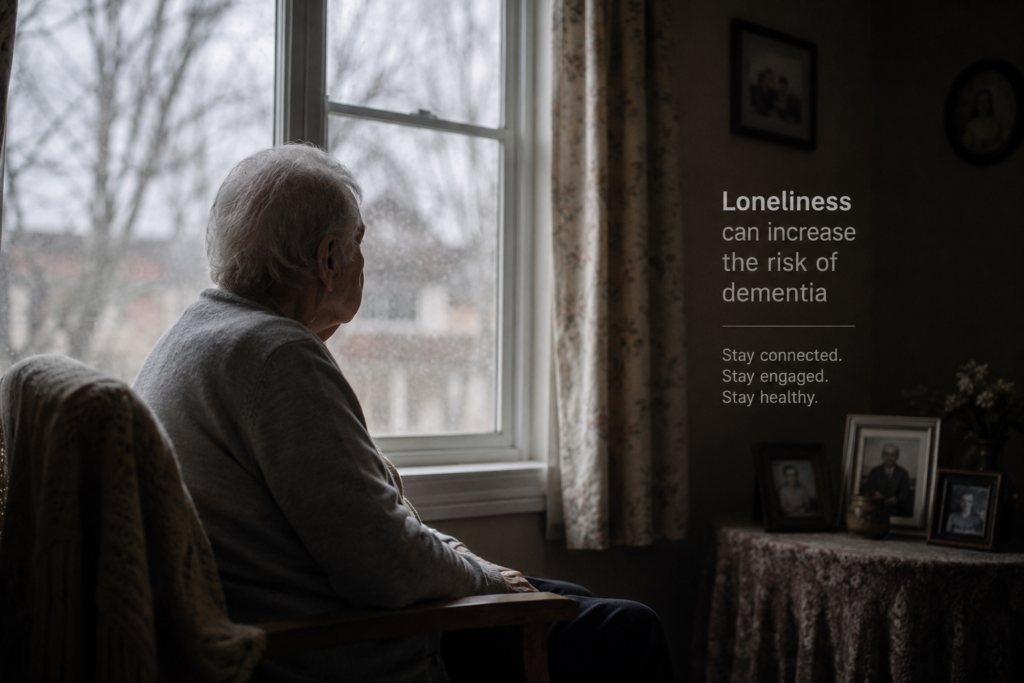
Picture this. You call your mother on a Sunday evening — the same call you make every week. But something feels different. She repeats herself twice in ten minutes. She asks about your father, forgetting he passed away years ago. She sounds distant, confused, and somehow smaller than you remember.
You hang up and tell yourself it is just old age. She is getting older. This is normal.
But what if it is not?
What if the real cause of what you are witnessing began not with a medical diagnosis — but with silence? With empty rooms? With years of quiet loneliness that nobody in the family noticed or took seriously?
New research is revealing something that should concern every family in the world: loneliness is not just an emotional experience. It is a medical emergency — and it is silently increasing the risk of dementia in millions of elderly people worldwide.
According to a major 2025 NIH analysis, loneliness increases dementia risk by 31%. Other large scale studies show risk increases ranging from 27% to 60%. To put this in perspective — loneliness carries mortality risks comparable to smoking 15 cigarettes a day.
This is not just a feeling. This is a brain health crisis unfolding quietly in homes across the world. And most families do not see it coming until it is too late.
The Science: How Loneliness Rewires the Brain
You do not need a medical degree to understand this. Think of your brain like a muscle. When it is exercised — through conversation, connection, laughter and social engagement — it stays strong and active. When it is left alone in silence for months and years, it begins to weaken.
Here is exactly what loneliness does to the brain:
1. It Creates Chronic Stress
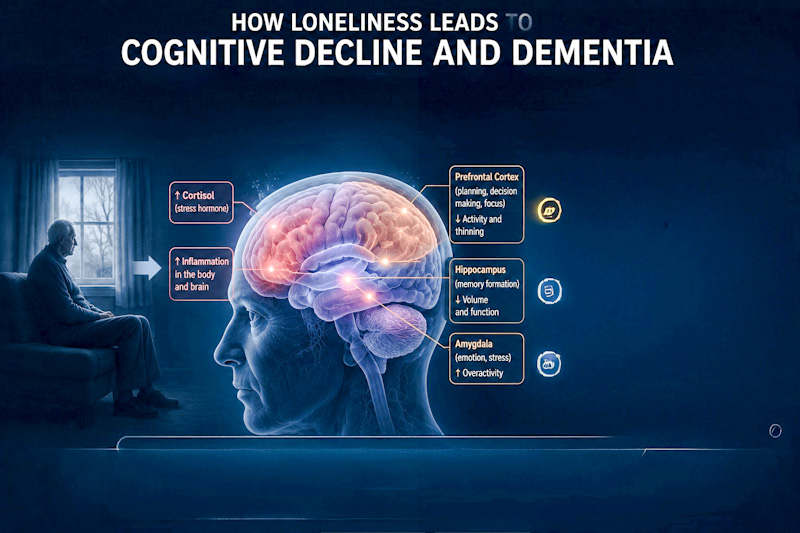
When a person feels lonely, their body produces high levels of cortisol — the stress hormone. A little cortisol is normal. But chronic, long term cortisol elevation causes inflammation throughout the body including the brain. This inflammation gradually damages brain cells and disrupts the neural connections that keep memory sharp.
2. It Causes the Brain to Shrink
This is perhaps the most alarming finding. Social engagement keeps neural pathways active and growing. Without regular human connection, the brain literally begins to atrophy over time. The areas responsible for memory and decision making are particularly vulnerable.
3. It Builds Up Toxic Proteins
Loneliness is linked to higher accumulation of amyloid plaques in the brain — the same toxic protein buildup that is a hallmark of Alzheimer’s disease. The lonely brain is, at a biological level, aging faster.
4. It Creates a Dangerous Cycle
Perhaps the most heartbreaking aspect of loneliness and dementia is how they feed each other. Loneliness leads to cognitive decline. Cognitive decline causes withdrawal from social situations. Withdrawal increases loneliness. And increased loneliness accelerates further decline. Once this cycle begins it is very difficult to break without intervention.
5. Loneliness and Depression Together Are Even More Dangerous
When loneliness is combined with depression — which is extremely common in isolated elderly people — the risk of dementia increases even further. The two conditions together carry a significantly higher risk than either one alone.
One powerful statistic to remember: Research suggests that if everyone maintained meaningful social connections throughout their lives, there could be nearly 5 fewer dementia cases per 100 people — meaning a significant proportion of dementia cases may actually be preventable.
Why This Is a Global Crisis
This is not a problem that belongs to one country or one culture. It is happening everywhere.
Globally, approximately 1 in 6 adults experiences loneliness. Among older adults, the numbers are even more concerning — between 24% and 29% of elderly people worldwide report feeling lonely, with some regions reporting rates above 30%.
In Western countries, the pattern is familiar. Nuclear families, geographic mobility, and busy modern life mean aging parents increasingly live alone. Children move to different cities or countries for work. Weekly phone calls replace daily presence. And slowly, quietly, an elderly parent becomes more isolated than anyone realizes.
But this crisis is equally real in South Asian, Middle Eastern and African communities — places where family togetherness has traditionally been a cultural strength. Rapid urbanization, migration and changing family structures are breaking down the extended family systems that once naturally protected elderly people from isolation. Children move abroad for better opportunities. Parents stay behind. The cultural expectation of family closeness remains — but the physical reality increasingly does not match it.
In Pakistani, Indian, Bangladeshi and other South Asian families specifically, this creates a painful contradiction. The cultural value of caring for parents is deeply held. But the practical reality of modern life — migration, work pressures, nuclear families — means many elderly parents spend far more time alone than their children realize or intend.
And in that silence, the brain begins to change.
7 Warning Signs Every Family Must Know
Understanding the connection between loneliness and dementia is important. But knowing the specific warning signs — the moments when loneliness has already begun affecting the brain — is what can actually save your loved one.
Here are the 7 warning signs that every family should recognize immediately:
Warning Sign 1 — Increased Withdrawal and Disinterest
Your parent was once social, curious and engaged. Now they show little interest in activities they previously loved. They stop calling friends. They decline invitations. They seem content to sit alone for hours. This withdrawal is not contentment — it is often an early sign that the brain is struggling.
Warning Sign 2 — Repeating Questions or Stories
Your mother asks the same question three times in one conversation. Your father tells the same story he told last week, completely unaware he has already shared it. Repetition in conversation — especially about recent events — is one of the earliest and most recognizable signs of cognitive decline triggered by isolation.
Warning Sign 3 — Confusion About Time and Recent Events
Your parent loses track of what day it is. They cannot remember what they ate for breakfast but can describe in perfect detail a wedding from thirty years ago. This pattern — clear long term memory alongside failing short term memory — is a classic early warning sign.
Warning Sign 4 — Personality and Mood Changes
A previously gentle, patient person becomes irritable, suspicious or even aggressive. A calm and composed individual starts overreacting to small things. Sudden personality changes — especially increased anxiety, paranoia or emotional volatility — can signal that loneliness has begun affecting brain chemistry.
Warning Sign 5 — Neglecting Personal Care and Appearance
Your parent, who was always well dressed and well groomed, stops caring about their appearance. They wear the same clothes for days. Personal hygiene declines. For families who knew their parent as someone who took great pride in their appearance, this change can be particularly shocking — and it is a significant warning sign.
Warning Sign 6 — Difficulty With Familiar Tasks
Your parent cooked the same recipes for forty years — and suddenly cannot follow them. They forget how to use appliances they have used for decades. Managing money, paying bills or operating a mobile phone becomes confusing and overwhelming. When familiar tasks become difficult, the brain needs urgent attention.
Warning Sign 7 — Getting Lost or Confused in Familiar Surroundings
This is often the warning sign that finally makes families act. Your parent steps outside their home — a home they have lived in for twenty or thirty years — and cannot find their way back. Or they become confused about which room is which inside their own house. Spatial disorientation in familiar environments is a serious warning sign that should never be ignored.
The Loneliness You Might Be Missing
One of the most important things to understand about elderly loneliness is that it is often invisible — even to the person experiencing it.
Many elderly people do not say “I am lonely.” In fact, in many cultures, admitting loneliness is seen as a burden or a weakness. They will say “I am fine.” They will tell you not to worry. They will insist they are managing well.
But watch for these hidden signs of loneliness in your elderly parent:
- They seem unusually excited or emotional when you visit — as if your presence is the highlight of their entire week
- They talk excessively when you call, reluctant to end the conversation
- They watch television for most of the day as a substitute for human company
- They mention the same neighbors, shopkeepers or delivery people repeatedly — because these brief interactions have become their primary social contact
- They seem more forgetful or confused on days when they have had no social contact
What You Can Do — Practical Steps for Every Family

The good news — and it is genuinely good news — is that loneliness is one of the most modifiable risk factors for dementia. Unlike genetics or age, it is something families can actually change.
Here is what the research recommends and what real families have found helpful:
1. Prioritize presence over presents Regular physical visits matter far more than gifts or money sent from a distance. Even one additional visit per week can make a measurable difference in your parent’s cognitive health.
2. Create a daily connection routine A five minute video call every morning gives your parent something to look forward to. It provides daily mental stimulation, emotional connection and a sense of being valued and remembered.
3. Encourage group activities Mosques, community centers, religious study circles, neighborhood gatherings — any regular group activity that involves conversation and human connection helps protect the brain. Help your parent find and attend these regularly.
4. Do not dismiss the warning signs If you recognize any of the 7 warning signs listed above, act immediately. Visit a neurologist or psychiatrist — not just a general physician. Ask specifically for a cognitive assessment. Early diagnosis makes an enormous difference to outcomes.
5. Seek professional support when needed Caring for a lonely or cognitively declining parent is emotionally exhausting. Do not try to do it alone. Involve siblings. Talk to a doctor. Reach out to support groups. Protecting your own mental health while caring for your parent is not selfish — it is essential.
A Personal Note
I know this topic from the inside. I watched my own mother — a strong, beautiful, immaculately dressed woman — change before our eyes after my father passed away and we all moved to our own homes. We thought she was fine. We thought she was managing.
We did not see the loneliness. We did not see the silence. And by the time we recognized what was happening, her dementia was already advanced.
If you want to read her full story — and understand exactly how dementia looks from inside a real family — I invite you to read: My Mother Had Dementia — And We Didn’t Even Know
It might be the most important article your family reads this year.
The Bottom Line
Can loneliness cause dementia? The research says yes — powerfully and clearly. Loneliness is not just sadness. It is a biological process that changes the brain, accelerates cognitive decline and significantly increases the risk of dementia.
But it is also preventable. With awareness, attention and action, families can protect their elderly loved ones from the silent damage of isolation.
Share this article with every family member who has an aging parent. Because somewhere right now, an elderly mother or father is sitting alone in a quiet room — and the family does not know the clock is ticking.
Do not wait until it is too late. 💙
If you’re already caring for a parent and starting to feel the weight of it, our guide on recognizing and coping with caregiver burnout walks through exactly what that looks like — and how to get through it.
Have a question or want to share your own experience? Leave a comment below — your story might help another family going through the same thing.
Pingback: My Mother Had Dementia — And We Didn't Even Know: A Real Story Every Pakistani Family Must Read - mentalhealthmatter