

There’s a particular kind of tired that doesn’t go away with sleep. It’s the tiredness you feel when you’ve helped your father get dressed for the third time today because he forgot he already did it. It’s the tiredness of answering the same question “where’s your mother?” for the hundredth time, gently, like it’s the first. It’s the tiredness that sits in your chest even when you’re sitting still, the kind that no amount of coffee or a good night’s rest seems to touch.
If you’re caring for a parent with dementia, you already know this feeling. And if you’re reading this at 11 PM after everyone else is asleep, wondering why you feel so empty even though you love them so much, you’re not broken, and you’re not alone. What you’re experiencing has a name: caregiver burnout, and it’s far more common than most people talk about.
If you’ve recently started noticing memory changes in a parent and are still making sense of what’s ahead, you might also relate to My Mother Had Dementia — And We Didn’t Even Know, a real story from a family that walked this exact path.
In fact, recent surveys show that more than three-quarters of family caregivers experience feelings of burnout, with many describing it as something that shows up weekly, sometimes daily, rather than as a rare bad week. This isn’t a small, private struggle. It’s one of the most under-discussed public health issues affecting families today, and dementia caregiving sits at the most demanding end of that spectrum.

What Is Caregiver Burnout, Really?
Caregiver burnout isn’t just “being tired.” It’s a state of physical, emotional, and mental exhaustion that builds up slowly, often without you noticing, until one day you realize you have nothing left to give not even to yourself.
It happens because dementia caregiving is different from most caregiving roles. There’s no finish line. No “getting better.” You’re not just managing tasks; you’re slowly losing the person you knew, one memory at a time, while still showing up every single day to care for them. Researchers sometimes call this “the long goodbye”—grieving someone who is still right in front of you.
The numbers paint a sobering picture. Nearly 70% of dementia caregivers report high levels of stress, putting them at real risk for burnout, and dementia caregivers are about twice as likely to be hospitalized themselves compared to people who aren’t caregiving. Among caregivers broadly, stress and anxiety affect the vast majority at some point, with more than half experiencing it on at least a weekly basis, and feelings of being completely overwhelmed running almost as high. Your exhaustion isn’t a personal failing. It’s a documented, predictable response to an extraordinarily demanding role—one that science is only now starting to take seriously.
The Four Stages of Caregiver Burnout
One thing that often helps caregivers is realizing that burnout doesn’t happen overnight; it builds in recognizable stages. Knowing which stage you’re in can help you understand how urgently you need to act.
Stage 1: The Warning Stage. This is where most caregivers start — full of love, energy, and a genuine desire to help. But cracks begin to show: occasional irritability, minor memory slips of your own, trouble sleeping. It feels manageable, so it’s easy to brush off.
Stage 2: The Control Stage. You start over-functioning—taking on more and more, often refusing help because “no one else does it the way I do.” You may feel a growing sense of needing to control every detail of your parent’s care, partly because it gives you a feeling of stability in an unpredictable situation.
Stage 3: The Survival Stage. Here, exhaustion becomes chronic. You may feel emotionally distant from your parent, going through the motions rather than feeling present. Many caregivers describe feeling “numb” at this stage, alongside guilt for feeling that way.
Stage 4: Full Burnout. This is significant depletion physically, emotionally, and mentally. You may feel inadequate, hopeless, or like you’ve lost yourself entirely in the role. At this stage, professional support isn’t optional anymore; it’s necessary.
If you recognize yourself in stage two or three right now, this is actually good news in one sense; you’ve caught it before stage four. There’s real room to turn things around.
Signs You Might Be Burning Out
Burnout doesn’t usually announce itself loudly. It creeps in. Here’s what it often looks like, broken down by category:
Physical signs:
- Constant fatigue, even after a full night’s rest
- Frequent headaches, muscle tension, or unexplained body aches
- Getting sick more often than usual, or slower to recover
- Noticeable changes in appetite — eating too little or stress-eating
- Disrupted sleep, even when you finally get the chance to rest
Emotional signs:
- Feeling numb, detached, or like you’re “just going through the motions”
- Irritability, or snapping at people you love over small things
- Persistent guilt — for resting, for feeling frustrated, for wanting a break
- A sense of hopelessness about the future, or about whether things will ever feel lighter
- Resentment, even toward the parent you love, followed by shame for feeling that resentment
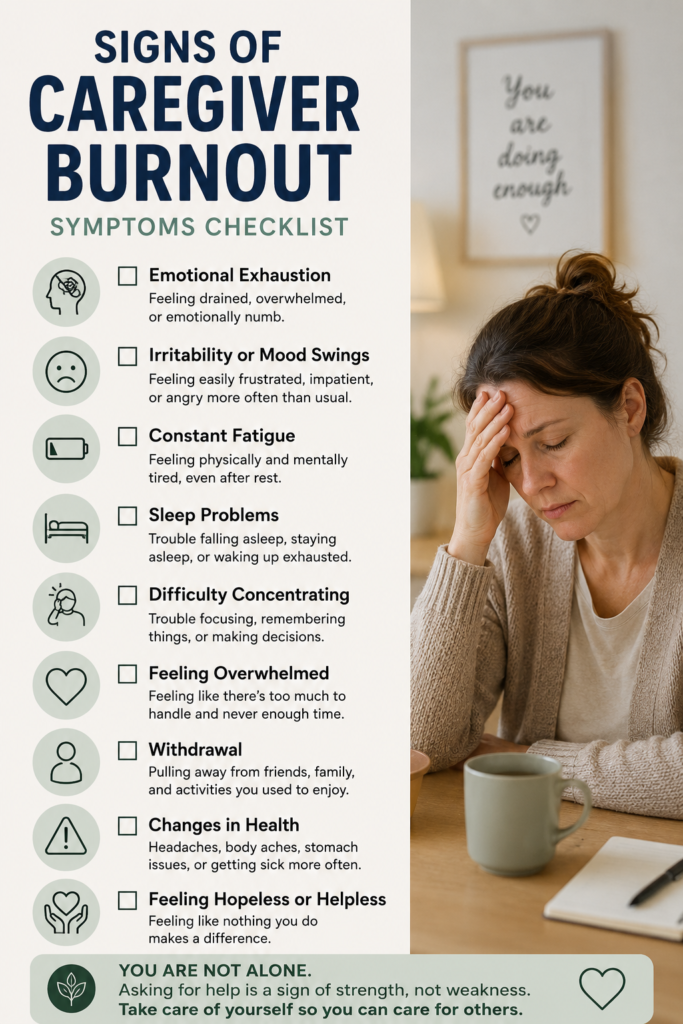
Behavioral signs:
- Withdrawing from friends, family, or activities you used to enjoy
- Neglecting your own health appointments studies show nearly three-quarters of family caregivers don’t go to the doctor as often as they should
- Feeling like you can’t leave the house, even for an hour, without anxiety
- Denial — insisting “everything’s fine” even as the signs pile up. Aging experts often point to this denial as one of the most telling warning signs of all, precisely because it delays getting help
If even three or four of these sound familiar, please know this isn’t a weakness. This is your body and mind telling you that the load has become too heavy to carry alone, and that something needs to shift.
When Culture Adds an Extra Layer of Guilt
For many of us, especially those raised in collectivist, family-first cultures, whether South Asian, Filipino, Middle Eastern, Caribbean, or African households, caregiving isn’t just a responsibility. It’s an identity. It’s what a “good son” or “good daughter” does. There’s often no real concept of stepping back, hiring outside help, or saying “I need a break” without an undercurrent of shame attached to it.
Add immigration into the mix, and it gets even more layered. Maybe you’re caring for a parent long-distance, torn between your life abroad and a parent who’s slipping away back home. Maybe you moved your parent in with you, and now you’re caught between Western individualism, which says “set boundaries, protect your peace,” and the voice in your head that grew up hearing “this is just what family does.”
If you’ve ever felt guilty for being exhausted or felt like you couldn’t say out loud how hard this is because “at least they’re not in a stranger’s hands,” you’re not imagining that pressure. It’s real, and it’s heavier for people carrying both the caregiving burden and the cultural expectation to carry it silently and perfectly.
This cultural weight often shows up as a very specific kind of guilt: the guilt of even considering a care home, a part-time aide, or a support group, as though needing help is itself a betrayal. It isn’t. Cultures that prize family devotion also, ideally, want their children to survive the role of caregiver intact, not to be quietly destroyed by it in the name of loyalty.
It’s Not Selfish to Need a Break
This needs to be said plainly: needing rest does not mean you love your parent any less.
You can be devoted to someone and still be human enough to need sleep, connection, and a moment where you’re not “on duty.” Burnout doesn’t make you a worse caregiver — it makes you a less effective one, which ironically hurts the person you’re trying so hard to protect.
Compassion fatigue is real too — and it’s different from general burnout. It’s what happens when you’ve absorbed so much of your parent’s confusion, fear, or distress that you start carrying it as your own until you can no longer tell where their pain ends and yours begins. Recognizing this isn’t selfish. It’s necessary maintenance, the same way you’d refuel a car before a long drive, not after it’s already stalled on the highway.
Many caregivers also don’t realize how financially and socially layered burnout can be. It’s not only emotional— caregiving often comes with real financial strain, disrupted careers, and a shrinking social circle, all of which compound the exhaustion. Naming all of these layers, rather than just the emotional one, often helps caregivers feel less like something is “wrong” with them and more like they’re responding normally to an enormous set of demands.

Practical Ways to Cope
You don’t need a perfect solution; you need small, sustainable shifts. Here are a few places to start:
Build a rotation, even an informal one If you have siblings or relatives, even two hours a week of someone else taking over can be the difference between functioning and collapsing. It doesn’t have to be an official “schedule”; even a WhatsApp message asking, “Can you sit with Abbu Sunday morning?” counts.
Look into respite care options, even part-time. This can mean a few hours of in-home help, a day program, or a trusted neighbor or community member stepping in. Many caregivers feel they have to do it “all themselves” you don’t, and you were never meant to.
Schedule recovery time like you’d schedule a doctor’s appointment. Put rest on the calendar. If it’s not scheduled, it tends to disappear.
Protect small windows of time for yourself. Even 15 minutes of quiet tea, a short walk, or calling a friend matters more than it seems, especially when it happens consistently rather than “someday when things calm down.”
Talk to someone who gets it. Whether that’s a support group, a therapist, or even another caregiver online, putting words to what you’re feeling lightens the weight in a way that staying silent never does
Lower the bar on “doing it all perfectly.” Some days, getting through the day is the win. That’s enough.
Plan ahead before a crisis forces your hand. Many caregivers later say they wish they’d started planning sooner, before an urgent situation pushed them into decisions made under panic rather than clarity. Even loosely exploring options now — without committing to anything — can save you from a much harder scramble later.
When to Seek Professional Help
If you notice ongoing sadness, hopelessness, anxiety that won’t ease, or thoughts of harming yourself, please reach out to a mental health professional or doctor. Caregiver burnout left unaddressed can deepen into depression or serious health problems of your own — research suggests that nearly half of family caregivers providing intensive, round-the-clock-level care experience clinical depression at some point. Getting support isn’t giving up. It’s how you stay standing long enough to keep showing up for your parent
A therapist experienced in caregiver stress can help you process complicated feelings, grief, resentment, and guilt without judgment. A support group, in person or online, can remind you that you’re not the only one who has felt this way, even when culture or distance makes it feel like you’re carrying this completely alone.

Frequently Asked Questions
Is caregiver burnout the same as depression?
Not exactly, though they’re closely related and often overlap. Burnout is a state of exhaustion tied specifically to the caregiving role, while depression is a broader mental health condition. However, untreated burnout can develop into depression, which is why early support matters.
How long does caregiver burnout last?
There’s no fixed timeline — it depends on how early it’s recognized and what changes are made. Some caregivers feel relief within weeks of adjusting their support system; others need longer, especially if professional help or a change in caregiving arrangements is involved.
Can I still be burned out if I love taking care of my parent?
Yes, completely. Love and burnout are not opposites — you can deeply love someone and still be exhausted by the role of caring for them. One doesn’t cancel out the other.
What’s the difference between caregiver burnout and compassion fatigue?
Burnout is broader, general exhaustion from the demands of caregiving. Compassion fatigue is more specific — it’s the emotional toll of absorbing someone else’s suffering so deeply that it starts to feel like your own.
You Are Allowed to Struggle With This
Loving someone with dementia and being exhausted by caring for them are not contradictions; they exist together, all the time, for almost everyone in this role. If no one has told you this lately, what you’re doing is hard, what you’re feeling is valid, and asking for help is not a betrayal of your parent or your culture. It’s what will let you keep loving them, for as long as you both have left.
If this resonated with you, you might also want to read Can Loneliness Cause Dementia? 7 Warning Signs Every Family Must Know — understanding what’s ahead can sometimes make the caregiving journey feel a little less overwhelming.