

By Mental Health Matter
Introduction
Let me paint you a picture.
It is Monday morning. There is a meeting. Nothing big — just a regular weekly catch-up. But from the moment you wake up, there is a heaviness in your chest. You rehearse what you might say in the shower. You go over possible questions your manager might ask. You arrive early, choose a seat near the door, and spend the entire meeting willing yourself to stay invisible.
When it’s over, you’re left exhausted. Not because the meeting was difficult. But because pretending to be fine is the hardest job you do every single day.
If you just nodded reading that — this article is for you.
Social anxiety at work is something millions of people are living with right now, quietly and completely alone. It is not shyness. It is not being introverted. This fear goes beyond ordinary workplace stress. It is the constant worry of being judged, watched, or humiliated—a burden that can hold people back from reaching their full potential. Today, we’re shedding light on it and talking about it honestly. Today we are going to talk about it honestly. We are going to name the signs that nobody else sees. And we are going to give you real, practical tools to start feeling better — one small step at a time.

What Is Social Anxiety at Work — and Why Is It Different from Just Being Nervous?
Here is something important to understand first. Feeling nervous before a big presentation or a job interview? That is completely normal. Every human being feels that.
But social anxiety at work is something different. It is when the fear does not go away after the presentation. It is when a simple team lunch feels as threatening as a performance review. It is when the fear of being judged is so constant and so overwhelming that it starts to affect your ability to do your job—and to enjoy your life.
Clinically, Social Anxiety Disorder involves a persistent fear of social situations where you might be scrutinized, judged or embarrassed. The fear feels completely out of proportion to the actual situation — you know that logically, a team meeting is not dangerous. But your body and mind do not get that message.
What makes the workplace particularly difficult is that it combines everything that triggers social anxiety at once — people in authority who evaluate you, colleagues who observe you, situations where you are expected to speak, perform, and be visible. There is nowhere to hide. And leaving entirely is not really an option.
Unlike shyness — which is just a personality trait — workplace anxiety causes real harm. To your career, your relationships and your mental health. Left unaddressed, it tends to grow stronger and harder to manage
8 Signs You Are Struggling Silently
These are the signs that look like something else to everyone around you — but that you know, deep down, are something more.
Sign 1 — You Dread Meetings — Even Small Ones
The calendar notification pops up and your stomach sinks. It is just a fifteen-minute team update. But suddenly your heart is beating faster and your mind is already racing through everything that could go wrong.
You arrive early. You sit near the exit. You have a script prepared in your head. And you spend the entire meeting doing one thing — staying invisible.
To your colleagues you just seem quiet. To your manager you seem reserved. Nobody in that room knows that sitting there, being potentially looked at or asked something, is genuinely terrifying for you.
This is not personality. This is social anxiety at work — and it is more common than anyone talks about.
Sign 2 — You Overthink Every Interaction Long After It Is Over
The conversation ended an hour ago. But in your head it is still playing on a loop.
Did you talk too much? Too little? Why did your manager pause before answering — was she disappointed? Did that colleague give you a strange look? You replay every word, every silence, every tiny expression — searching for evidence of what you did wrong.
This is called post-event processing and it is one of the most exhausting features of social anxiety. The interaction is over but the anxiety keeps going — reviewing, analyzing, worrying.
From the outside you seem completely fine. Nobody knows you went home and spent two hours lying awake replaying a three minute conversation by the printer.
Sign 3 — You Stay Silent Even When You Have Something to Say
You have a good idea. You have been thinking about it all week. You know it could actually make a difference.
But as the meeting continues and the moment to speak gets closer, the fear kicks in. What if you say it wrong? What if someone disagrees and you cannot defend it? What if everyone thinks it is obvious or stupid?
So you say nothing.
And then five minutes later someone else suggests something very similar — and everyone agrees it is great.
This is one of the most heartbreaking and career-limiting effects of social anxiety at work. The potential within you has always been there. The challenge is that the fear of judgment can sometimes drown out the confidence needed to let it shine.
Sign 4 — You Are Exhausted in a Way Nobody Understands
You only had three conversations today. You attended one meeting. You sent a few emails. It was not a particularly demanding day.
So why do you feel like you ran a marathon?
People with social anxiety do not just interact with colleagues. They perform. Every single interaction involves managing fear, monitoring their own behavior, watching for signs of judgment, and maintaining the appearance of someone who is completely fine.
That performance is draining in a way that most people will never understand. And when you try to explain it — when you say you are tired from work even though nothing major happened — people just do not get it.
You look fine. You function. But inside, you are running on empty.

Sign 5 — You Avoid the Break Room — or Eat Alone at Your Desk
Lunch should be a break. But for you it is one of the most stressful parts of the day.
Who will you sit with? What will you talk about? What if an uncomfortable silence fills the room? What if you walk in and nobody makes room for you?
So you eat at your desk. Or in your car. Or you skip it entirely and tell yourself you are just busy.
The heartbreaking part is what happens next. Your colleagues stop inviting you because you always say no. You become more isolated. And the isolation makes the anxiety worse — which makes you avoid more — which increases the isolation. It is a cycle that tightens slowly, and most people do not even realize it is happening.
Sign 6 — Performance Reviews Fill You With Dread for Weeks Beforehand
Most people find performance reviews a little uncomfortable. For you, they are weeks of anticipatory anxiety that sits in your chest like a stone.
Being in a position where someone is openly assessing your performance and sharing their judgment can feel emotionally overwhelming. Even when you know you have done good work. Even when the feedback is likely to be positive.
And the worst part? Even good feedback does not really help. Because then you think, “What if I cannot keep this up?” What if next time they are disappointed?
Whether it’s a one-on-one meeting, a feedback session, or a simple request to chat, each situation can carry the same sense of anxiety and uncertainty.
Not because you are not capable. But because being truly seen and evaluated by another person is one of the most frightening experiences social anxiety can create.
Sign 7 — You Overprepare Everything — and Nobody Knows Why
You wrote five drafts of that email. You practiced your part of the presentation until you knew it by heart. You arrived thirty minutes early just in case.
From the outside this looks like professionalism. Dedication. Thoroughness. People probably compliment you on it.
But you know the truth. The overpreparing is not ambition — it is armor. It is your way of trying to eliminate any possible reason for criticism. If everything is perfect, nobody can judge you. If you are completely prepared, nothing can go wrong.
The problem is that this level of preparation is exhausting and unsustainable. And it feeds the anxiety rather than calming it — because it teaches your brain that the only way to be safe is to be perfect. And nobody can be perfect forever.
Sign 8 — Your Body Betrays You When All Eyes Are on You
Someone asks you a direct question in a meeting. And suddenly your face is hot, your voice comes out slightly wrong, your hands do not know what to do with themselves.
You are convinced everyone can see it. Which makes it worse. Which makes the symptoms worse. Which makes you more convinced people can see it.
This is the cruel feedback loop of social anxiety — the fear of showing anxiety produces the exact symptoms you are most afraid of showing. And no matter how many times you tell yourself to calm down, the body just keeps responding.
These physical symptoms — blushing, sweating, trembling, voice changes — are real physiological responses. “These physical reactions aren’t just nerves — anxiety produces some surprisingly strange body sensations that many people never connect to stress. If you’ve been wondering why your body feels off, our guide on the weird physical symptoms of anxiety explains exactly what’s happening.”They are not weakness. They are not a character flaw. They are what anxiety does to a body under threat. And they deserve compassion, not shame.
How Social Anxiety at Work Affects Your Career Over Time
If social anxiety at work goes unaddressed, the impact builds quietly over time:
Your productivity suffers because so much of your mental energy is spent managing fear rather than doing actual work.
You miss opportunities because you are seen as disengaged or lacking confidence — not because you are, but because anxiety is preventing your real abilities from being visible.
You burn out faster than colleagues who are not carrying this invisible weight every single day.
And slowly, without meaning to, you begin to shrink — taking up less space, contributing less, believing less in yourself.
But here is what I really want you to hear. None of this is permanent. None of this is your fault. Effective treatments and evidence-based strategies are available to help manage and overcome these challenges.
How to Cope with Social Anxiety at Work — Things That Actually Help
In the Moment — When Anxiety Spikes
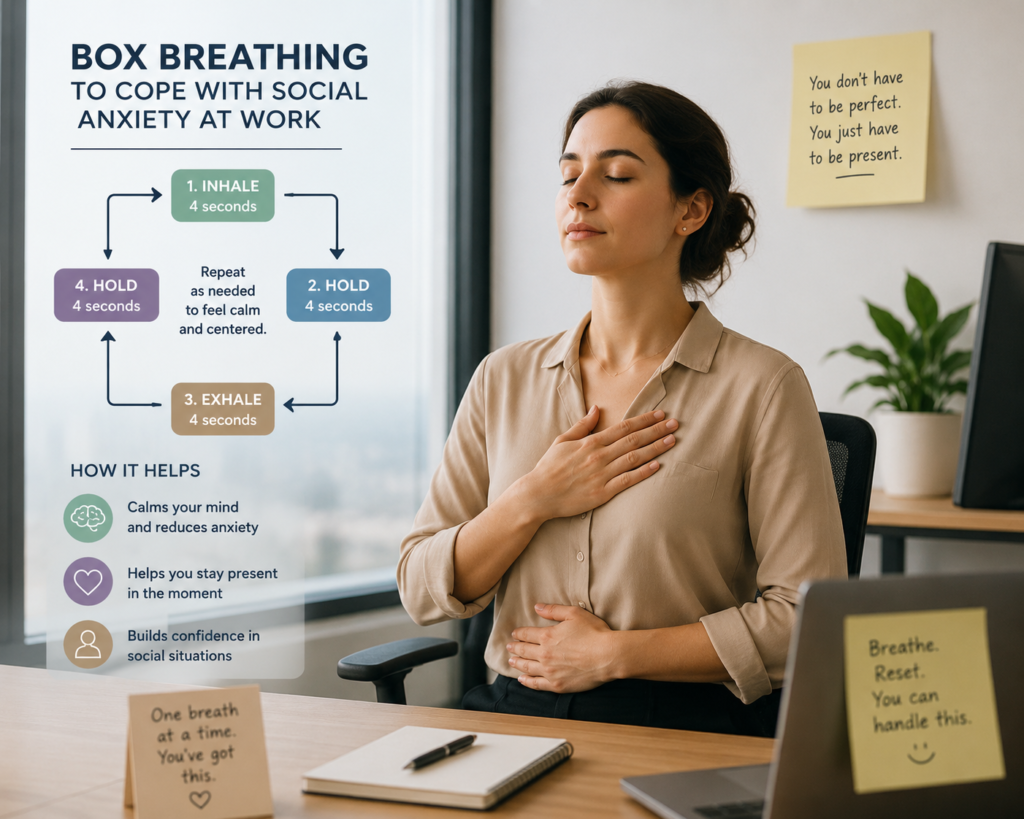
Box Breathing — 4-4-4-4 Breathe in for 4 counts. Hold for 4. Breathe out for 4. Hold for 4. Repeat three times. This works because it physically interrupts the stress response in your body — it is not just a distraction, it genuinely calms your nervous system. Use it before meetings, during difficult conversations, or any moment anxiety starts to rise.
The 5-4-3-2-1 Grounding Technique Name 5 things you can see. 4 you can touch. 3 you can hear. 2 you can smell. 1 you can taste. This pulls your attention out of the anxious spiral in your head and plants it firmly back in the present moment. It sounds simple. It genuinely works.
Reframe What the Anxiety Means Instead of thinking “everyone can see I am nervous” — try shifting to “my body is giving me energy for this moment.” Research actually shows that reframing anxiety as excitement rather than threat improves performance. Your nervous system cannot tell the difference between fear and anticipation. You can choose which story you tell yourself.
Long Term — Building Real Confidence
Cognitive Behavioural Therapy (CBT) If there is one thing I would recommend above everything else — it is this. CBT is the most evidence based treatment for social anxiety disorder and it works specifically well for workplace anxiety. It helps you identify the thought patterns driving the fear — “if I make a mistake everyone will think I am incompetent” — and replace them with more accurate, balanced thinking. Even a short course of 8 to 12 sessions can create lasting change.
Gradual Exposure Avoidance feels like relief. But avoidance is what keeps anxiety alive. The path forward is gradual, gentle exposure — starting with the smallest possible step and building slowly. Maybe that is making one comment in a small meeting this week. Then two next week. Each small success teaches your brain that the feared outcome does not actually happen. Over time the threat response genuinely reduces.
Challenge the Thoughts That Are Lying to You Social anxiety is built on thinking errors. Mind reading — “they think I am not good enough.” Catastrophizing — “if I stumble over my words, my career is over.” Personalizing—”Everyone noticed, and they are all judging me.”
These thoughts feel completely real. But they are not facts. Learning to question them—to ask “is this actually true? What is the evidence?” — is one of the most powerful things you can do for your long term mental health.
Build One Small Connection Instead of avoiding all informal interaction, set yourself one tiny goal. One brief genuine conversation per day with a colleague you feel comfortable with. Not a performance. Just a moment of real human connection. These small moments gradually rebuild the brain’s sense of social safety — and they matter more than you know.
When to Ask for Help
Please do not wait until things feel unbearable. If any of these are happening, reach out to a professional now:
- You are calling in sick to avoid specific situations at work
- You are having panic attacks
- Your anxiety is significantly affecting your performance or career
- You are feeling depressed or deeply isolated
- You are using anything alcohol, avoiding, or overworking to cope with the fear
Asking for help is not weakness. It is the bravest and most practical thing you can do. Talk to your doctor and ask for a referral to a therapist who specializes in anxiety. Many workplaces also offer free confidential counseling through Employee Assistance Programs — it is worth checking if yours does.
You do not have to figure this out alone.If you are also struggling with feelings of
isolation or loneliness, you might find our article helpful — Can Loneliness Cause Dementia?
7 Warning Signs Every Family Must Know.

A Final Word
You came to work today and you survived it. Again. Like you do every day.
And maybe nobody around you knows how much that costs you. Maybe nobody sees the exhaustion behind your composed face, or the fear behind your silence, or the effort it takes to simply show up.
But I see it. And I want you to know — you are not broken. You are not weak. You are not “too sensitive” or “not cut out for this.”
You are someone dealing with a real mental health challenge that has a name, a cause, and—most importantly a way through.
Social anxiety at work does not have to be your forever. With the right support, the right tools, and a little patience with yourself, the workplace can become a place where your real self finally gets to show up.
You deserve that. 💙